



 Black
Black White
White Grey
Grey Brown
Brown Red
Red Yellow
 Pink
Pink Skin Tones
 Orange
 Violet
 Green
Green Blue
Blue


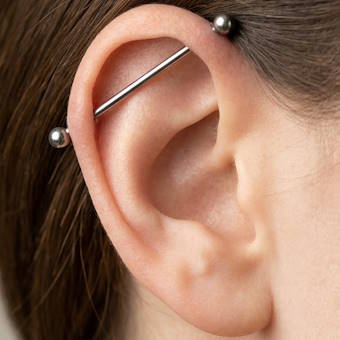


Industrial Piercing: Your Guide to Making a Bold Statement with Your Ears
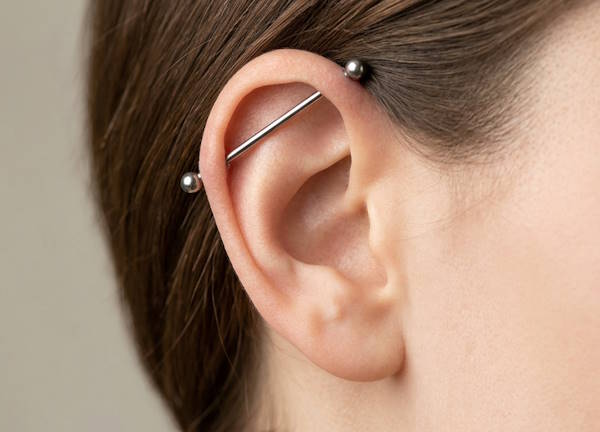
If you’re looking for a piercing that instantly catches the eye and adds a bold, unique touch to your look, then the industrial piercing is the way to go. It’s considered one of the most striking options in ear cartilage jewelry. In this article, you’ll learn everything you need to know about the piercing process, healing, and choosing the right jewelry to ensure your industrial piercing is a complete success.
What exactly is an industrial piercing?
Unlike most other piercings, the industrial is technically two piercings connected by a single piece of jewelry. In the classic version, a long barbell connects two opposite points in the upper part of your ear—usually a helix piercing on one side and an anti-helix piercing (forward helix) on the other.
What makes it special is its symmetry and technical aesthetic. Since the bar runs across the upper part of the ear, it creates an industrial, almost architectural look, which is where the piercing gets its name.
Anatomical requirements: Is it right for you?
Before you decide on an industrial piercing, it’s essential to get professional advice from a piercer you trust. Why? Because not every ear is suitable for a classic industrial piercing.
- The helix: Your upper ear must have a sufficiently pronounced helix (the rim of the ear) so that the bar can be securely anchored.
- The scapha: The area below the bar (the hollow of the ear) must not curve too far forward. If the bar constantly presses against the cartilage in the middle, it can lead to painful pressure points or inflammation.
If your anatomy doesn’t allow for a classic industrial, don’t despair: there are creative alternatives like “custom industrials,” where multiple bars or pieces of jewelry are connected in a crisscross pattern or at other angles.
The piercing process: Precision is everything
Placing an industrial piercing requires a lot of experience. Your piercer will first mark both entry points very carefully. The angle must be exactly right so that the bar sits tension-free later on. First, both holes are pierced individually with a sterile hollow needle. The long bar is inserted immediately afterward. Since you’re getting two cartilage piercings at the same time, the moment of pain is slightly more intense than with a simple ear piercing, but thanks to a professional’s expertise, it’s usually over in just a few seconds.
Materials: Quality for Your Health
Since the industrial piercing is located in the cartilage tissue, which generally has poorer blood circulation than the earlobe, you should not compromise on the material.
- Titanium (G23): We recommend titanium for your first piercing. It is biocompatible, nickel-free, and significantly lighter than surgical steel. This reduces pressure on the fresh piercing channels.
- Surgical steel 316L: This classic is ideal for piercings that have already fully healed. It is robust and can be polished to a high shine.
- Flexible PTFE: In cases of stubborn healing, a flexible plastic rod is sometimes used to relieve mechanical pressure on the cartilage. You can find this type of product in our shop as well.
Healing and Care: Patience Pays Off
You should know: An industrial piercing is a long-term project. Since two wounds are connected by a rigid bar, both channels influence each other. If you catch on one side, you often automatically irritate the other side as well. The healing phase usually lasts 6 to 12 months.
Your checklist for proper care:
- Cleaning: Spray a sterile care spray on the entry and exit points twice a day.
- No movement: Do not twist or move the barbell unnecessarily. This damages the newly formed tissue inside.
- Be careful when sleeping: Avoid lying on your pierced ear. A tip: A pillow with a hole or a simple neck pillow can help you get through the night without pressure.
- Hair care: Be extremely careful when brushing your hair and make sure no shampoo or hairspray gets into the fresh wound.
Styling options for your industrial piercing
Once your piercing has healed, the world of jewelry is open to you. In our collection, you’ll find classic straight barbells in various colors such as silver, gold, black, or rose gold. For that extra touch, there are bars with decorative elements in the center—such as small crystals, arrow designs, or geometric shapes.
An industrial piercing is a bold statement. With the right care and high-quality jewelry from our shop, you’ll enjoy this unique body piercing for a lifetime.