



 Black
Black White
White Grey
Grey Brown
Brown Red
Red Yellow
 Pink
Pink Skin Tones
 Orange
 Violet
 Green
Green Blue
Blue


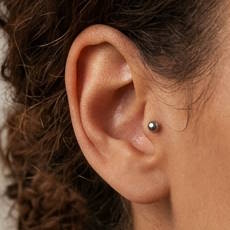


Tragus Piercing: The timeless classic among ear cartilage piercings

Over the past few decades, the tragus piercing has evolved from a trendy accessory to an absolute staple in the world of body jewelry. It is pierced through the small, thicker cartilage protrusion located directly in front of the entrance to the ear canal. Thanks to its central position in the ear, it attracts attention without appearing obtrusive. Whether as a subtle standalone piece or as part of a complex “curated ear” look—the tragus piercing offers a wide range of styling possibilities.
What makes the tragus piercing so special?
The name is derived directly from the anatomical term: The tragus (Latin for “goat’s horn,” due to the hair that grows there in some people) is a prominent point on the auricle. Since the tissue here consists purely of cartilage and no nerve pathways leading directly to the ear canal are blocked, it is an ideal spot for aesthetic jewelry. A particular advantage of this piercing is its versatility. It harmonizes perfectly with other piercings such as the helix, the rook, or classic ear piercings (lobe).
Choosing the Right Jewelry: Materials and Shapes
With a tragus piercing, the choice of material is crucial for comfort and the health of your ear. Since cartilage heals more slowly than soft tissue, low-quality jewelry should be avoided.
- Titanium (G23): The ultimate choice for initial and long-term jewelry. Titanium is nickel-free, biocompatible, and significantly lighter than surgical steel. It does not oxidize and offers the best tolerance.
- Surgical steel 316L: A cost-effective alternative to titanium for tragus piercings is surgical steel (stainless steel).
In terms of shapes, there are primarily two types of tragus piercings:
- Labret stud: This is the most recommended style. A labret has a flat plate on the inside (toward the ear canal). This prevents irritation in the ear and allows for comfortable use of in-ear headphones.
- Rings (ball closure rings or clickers): A ring in the tragus looks particularly striking. However, care should be taken to ensure that the ring is not inserted until the piercing has fully healed, as the constant movement of a ring can irritate the fresh piercing site.
The piercing process and pain perception
Many customers ask about the pain factor. Since the tissue on the tragus is quite firm and thick, you feel significant pressure during the piercing. However, the perception of pain is subjective. Most describe it as a brief, sharp sting that quickly turns into a throbbing sensation. It is important that the piercing is performed exclusively by a professional piercer using a sterile hollow needle (cannula). We strongly advise against using an ear piercing gun, as this can shatter the cartilage tissue.
Healing and Care: How to Keep Your Piercing Healthy
A tragus piercing requires patience. The healing phase usually lasts 3 to 9 months, and in some cases up to a year. Since cartilage has less blood flow than skin, metabolism—and thus healing—proceeds more slowly.
Care tips for quick healing:
- Hands off: Never touch the piercing with unwashed hands. Bacteria are the main cause of inflammation.
- Cleaning: Clean the area twice a day with a sterile saline solution or a special piercing care spray. Avoid harsh alcohol-based cleansers.
- Avoid pressure: Try not to sleep on your pierced ear during the first few weeks. A pillow with a hole or a neck pillow can help keep your ear off the surface.
- Be careful when styling: When washing your hair, combing it, and getting dressed, be careful not to catch the jewelry. Also, make sure that makeup and hairspray do not come into direct contact with the piercing site.
Styling trends: From minimalism to statement pieces
In our collection, you’ll find the perfect piece of jewelry for every style. Currently, minimalist studs like small beads, flat discs, or tiny stars are trending. Those who prefer something more eye-catching can opt for clusters, where multiple zirconia stones are arranged in a row or shape. Small chain elements stretched from the tragus to the helix are also growing in popularity.
A tragus piercing is more than just a hole in your ear—it’s an expression of individuality. With high-quality jewelry and proper care, you’ll enjoy this timeless accessory for years to come.
Tragus Piercing
Tragus—what is it? Anatomically speaking, the tragus refers to the cartilaginous part of the auricle. This part is a protrusion in front of the entrance to the external auditory canal. The cartilage can be elegantly adorned with a piercing, known as a tragus piercing. This piercing has no cultural or historical references. This piercing was once very common in various subcultures. It has since become a very popular standard piercing.
The tiny cartilage in the ear is a very sensitive area, and the piercing is not entirely painless. However, there are a few things you need to keep in mind to avoid complications. The piercer should have some experience, as piercing with an ear gun is not recommended, as is done, for example, with the earlobes. A straight or curved hollow needle, known as a venipuncture needle, is used for piercing. Bleeding usually occurs during the procedure because the ear cartilage is well-supplied with blood. The tragus muscle is also located here. If this is hit, you must be especially careful. Curved barbells or labret studs are always recommended as initial jewelry, even if you prefer to wear rings afterward. The initial jewelry should preferably be made of precious metal or surgical steel; this is less painful and helps the piercing heal better, as it contains little to no nickel. Alternatively, PTFE can also be used as a material.
The ear should be disinfected before piercing, as there is a risk of infection. Swelling of the cartilage is normal and should subside after some time. Applying cold compresses can help. However, you should also be aware of the risks associated with piercing. Nerves can be damaged, potentially leading to facial paralysis. If inflammation occurs, seek professional help immediately, either from the piercer or a doctor. You should also avoid visiting swimming pools and saunas for the time being. The healing process can take up to 3 months.
Clean your new tragus piercing only with clean hands. You can purchase several care products for this purpose in our Murostar Shop. We offer our PRIONO piercing spray as well as Octenisept.
What jewelry can you use? Among other options, a ring—also known as a ball closure ring—is very popular. You can also use segment rings or a labret stud. All these products are available at Murostar in various shapes, colors, and sizes. You can also choose which material suits you best.